
MONARCH MEMORY(H.K.)CO.,LIMITED
HOTLINE
8618770187778
MEMS devices have good applications in RF and wireless communication. The quality factor of RF MEMS resonators and inducers is greatly improved in microwave. MEMS switches greatly improve high-frequency performance and reduce energy consumption.
Since 1979, K. Peterson (K. Since E. Petersen proposed microfabricated relays, many types of MEMS switches have been developed. With the development of microfabrication technology, the price of MEMS switches has decreased due to the reduction of material costs and the extension of service life.
MEMS switches are switches integrated on ordinary silicon wafers using micromachining technology. It is used in RF to millimeter wave (0.1 to 1000GHz) communications. Compared with traditional semiconductor devices such as bipolar transistors and metal-oxide field-effect transistors, MEMS switches have the advantages of low signal distortion, signal separation from the driver, low power consumption, good linearity, small size, and long lifetime. It can be widely used in remote communication systems, wireless communications, automatic test equipment, and rapid data acquisition.
MEMS switches work on a variety of principles, most of which are electrostatically driven. The micro-contact force of MEMS switches ranges from tens to hundreds of micronewtons, and its basic electrical properties are mainly in this range, such as contact resistance, breakdown voltage, heat dissipation, and surface damage.
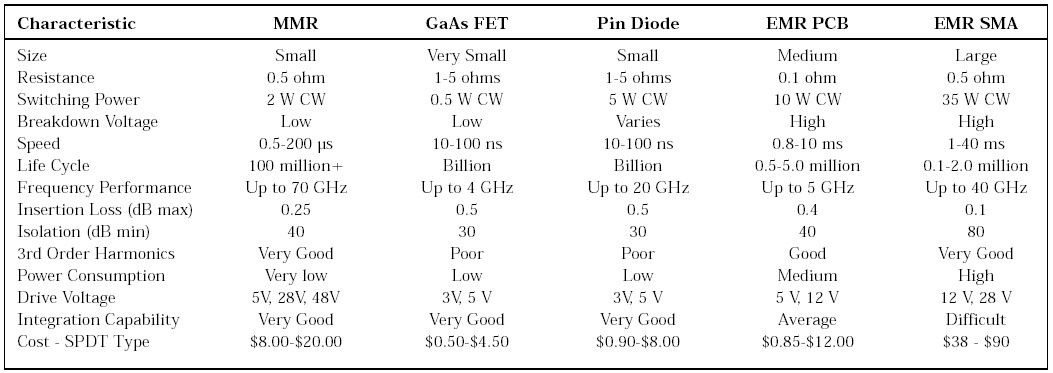
Table 1 shows the performance comparison of MEMS relays (MMRs) with potassium arsenide FETs, diodes, and electromagnetic relays (EMRs).
The structure of most MEMS switches consists of three parts: (1) mechanical movable parts – cantilever or beam; (2) Electric drive components - capacitors or coils; (3) Signal line - contact point and lead. Corresponding to different driving mechanisms, the corresponding MEMS switch types include electrostatic, electromagnetic, piezoelectric, and thermal. Here are a few typical MEMS switches.