
MONARCH MEMORY(H.K.)CO.,LIMITED
HOTLINE
8618770187778
The deep reactive ion etching process is an important way to achieve high aspect ratio characteristics and has become the cornerstone of microfabrication technology. This etching technology has been used in many fields: 1) MEMS capacitive inertial sensor; 2) miniaturization of macro equipment; 3) Through silicon process of 3D integrated circuit stacking technology.
For inertial MEMS sensors, it has been found that the prepared capacitive accelerometer has a high aspect ratio structure, which can significantly increase the sensing area, provide higher verification quality and reduce the spring rate, thereby improving the capacitance sensitivity. In the field of 3D integrated circuit packaging, multiple chips connected vertically on a single substrate can significantly improve device performance and reduce size, and for through-hole structures of the same diameter, a larger aspect ratio helps solve heat dissipation and warpage problems. Since the surface morphology of the etching structure is closely related to the line width of the etching area, the gas transmission is limited to a certain extent with the increase of the etching depth of the tiny linewidth structure, and the weakening of the ability caused by the lack of active gas etching is the main factor restricting the increase of the height-to-depth ratio of small line width.
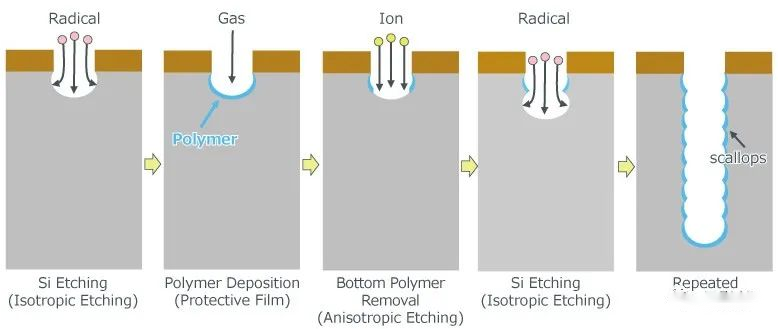
The most common application of deep reaction ion etching is the [Bosch process], which is based on the alternation of etching and passivation, and decomposes an etching cycle into three sub-processes: carbon fluoropolymer deposition, passivation layer etching and silicon etching, corresponding to Dep1, Etch1 and Etch2 in the etch menu respectively.
In order to improve the dependence of etching on the aspect ratio, the etching time of the Etch2 subprocess and the plate power in the two etching processes of Etch1 and Etch2 are gradually increased without changing the coil power and chamber pressure, which increases the reaction gas on the one hand and provides more time for the diffusion of the reaction gas and the separation of the reaction products. On the other hand, if the opening size increases with the increase of the etching depth, it indicates that the thickness of the passivation layer on the current side wall is not enough to protect the lateral from etching, and Dep1 needs to be increased or Etch1 needs to be decreased.
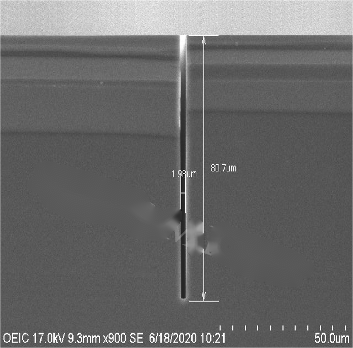
Through the optimization of the process parameters, the following figure shows a 2μm line width etching depth of 80 microns, and the aspect ratio is 40:1.